First AI discovered zero-day exploited in wild attacks
Quick Scribbles
-
Google Threat Team — First AI-discovered zero-day exploited in wild attacks, bypassing 2FA authentication.
-
Spatial AI — Next platform shift moves beyond flat screens to environment-aware intelligence systems.
-
Public Sentiment — 70% of Americans say AI moving too fast; data center cancellations accelerating.
-
Automation Paradox — AI companies face demand crisis as automation eliminates their customer base.
Good morning, AI Knowledge Worker. Security researchers just documented a watershed moment in cybersecurity. An AI model found a zero-day vulnerability. Attackers exploited it in live systems.
The discovery didn’t come from OpenAI or Anthropic. Smaller models now hunt vulnerabilities without safety constraints. What happens when exploit discovery runs at machine speed?
In this issue:
-
First AI-discovered zero-day exploited in wild
-
Spatial computing becomes AI’s next platform
-
70% of Americans say AI moves too fast
-
The automation paradox threatening AI economics
First AI-Discovered Zero-Day Exploited in Wild—And It Wasn’t From a Frontier Lab
The Scoop: Google’s threat team caught attackers weaponizing an AI-discovered vulnerability. The exploit came from an unnamed AI model.
The Technical Details:
-
The vulnerability was a 2FA authentication bypass in open-source software components.
-
Smaller AI models lack the safety guardrails frontier labs implement in systems.
-
These unrestricted models can scan codebases for exploitable logic flaws continuously.
-
Google’s detection relied on behavioral analysis of attack patterns, not signatures.
-
The unnamed model likely operates without content filters blocking security research outputs.
Why It Matters for You: Security teams cannot rely on frontier lab safety measures alone. Attackers now possess automated vulnerability discovery tools operating at machine speed. Budget allocation must shift toward AI-powered defensive capabilities immediately. The competitive intelligence risk extends beyond technical exploits to business logic vulnerabilities. This development compresses the window between vulnerability discovery and active exploitation.
The Bigger Picture: This marks cybersecurity’s transition into an AI-versus-AI arms race era. The vulnerability source matters less than the acceleration of discovery capabilities.
Spatial AI: Why the Next Platform Shift Won’t Happen on Flat Screens
The Scoop: AI is converging with spatial computing to create intelligence that understands physical environments. Current text-prompt systems will be displaced by AI that knows where you are.
The Technical Details:
-
Spatial AI uses three-layer architecture: device edge, spatial intelligence layer, and cloud AI reasoning
-
The device edge collects environmental data under 20ms latency constraints using LiDAR and IMUs
-
Spatial context builders assemble camera frames, depth maps, and anchor states into LLM prompts
-
The spatial intelligence layer handles context assembly, anchor resolution, and memory retrieval before LLM calls
-
Context window management requires filtering nearby anchors and object detections to prevent reasoning degradation
Why It Matters for You: Teams building AI agents today design for browser interfaces that are becoming obsolete. Spatial AI requires fundamentally different architecture for context, memory, and latency. Engineers with both AI systems expertise and AR development experience remain extremely rare. Early investment in spatial-native AI architecture provides five-year competitive positioning advantage. Current agent workflows don’t translate when physical location becomes the primary context.
The Bigger Picture: Every major platform shift arrived before the mental model caught up. The internet existed before people understood living online. Smartphones existed before anyone grasped the always-connected web. Spatial AI follows the same pattern as those transformations.
AI Backlash Hits Critical Mass: 70% Say Technology Moving Too Fast
The Scoop: Public sentiment against AI collapsed across all demographics. Data center cancellations now threaten compute availability for enterprise deployments.
The Technical Details:
-
Economist/YouGov polling shows 70%+ of Americans say AI advances too quickly.
-
Negative AI views rose from 34% to 50% over three years.
-
Record data center cancellations occurred in Q1 2026 per Heatmap Pro data.
-
Only 18% of 14-29 year-olds report feeling hopeful about AI.
-
Morgan Stanley flags public pushback as binding constraint on infrastructure growth.
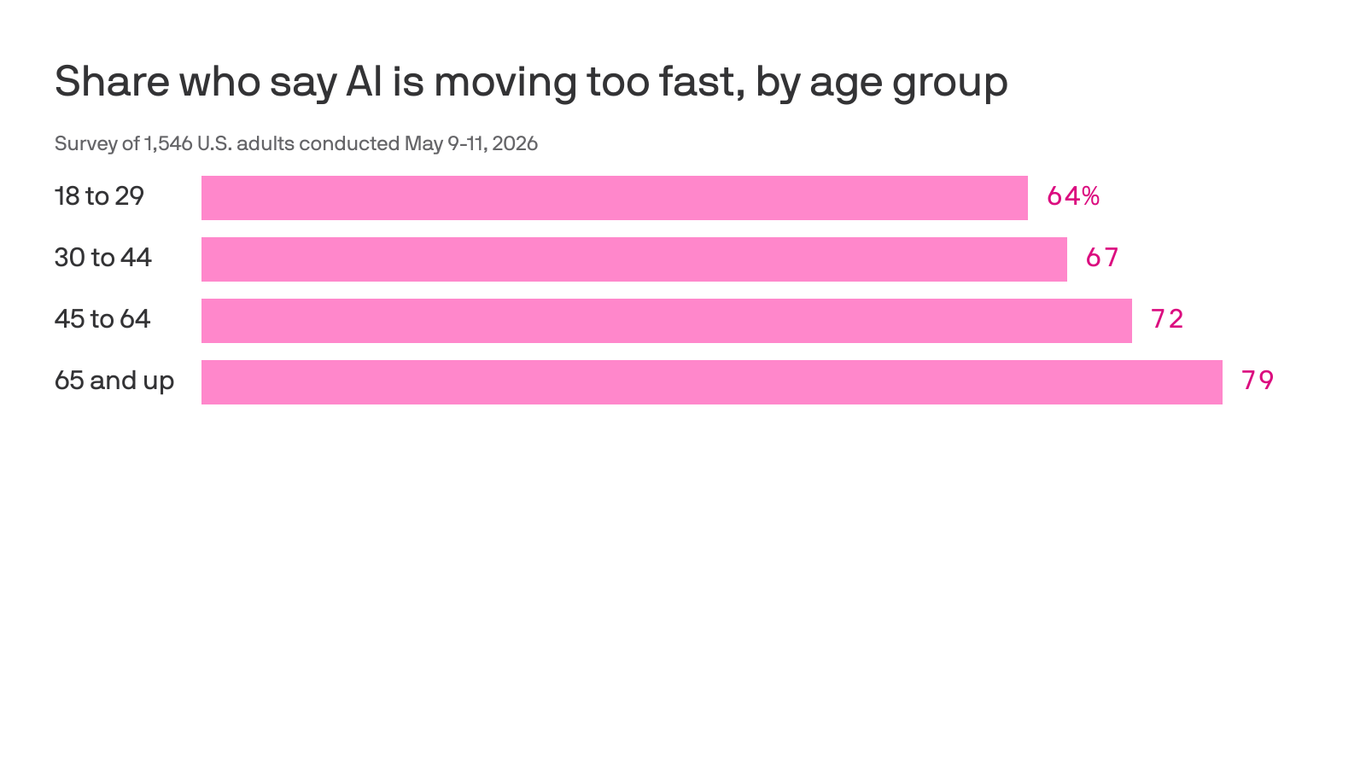
Why It Matters for You: Enterprise sales cycles will lengthen as procurement teams face internal resistance. Your AI vendors now compete against rising organizational skepticism about ROI. Data center constraints mean compute access limitations could delay production deployments. The gap between executive optimism and workforce distrust creates implementation blind spots. Customer conversations must shift from capability demos to trust-building and compliance.
The Bigger Picture: This mirrors the social media reckoning of 2018-2020. Early adoption enthusiasm collapsed into regulatory scrutiny and platform redesigns.
The AI Automation Paradox: Who Buys Your Products After You Fire Your Customers?
The Scoop: AI automation faces a fundamental contradiction: replacing workers eliminates the customer base needed for AI subscriptions.
The Technical Details:
-
Current AI business models depend on subscription revenue from employed knowledge workers.
-
Automation economics assume cost savings exceed revenue loss from displaced customers.
-
Universal Basic Income proposals from tech executives aim to maintain consumer purchasing power.
-
Closed-loop systems would route government payments back to tech companies via subscriptions.
-
Historical precedent shows similar labor-to-consumer transitions during industrial automation waves.
Why It Matters for You: AI companies face a structural demand problem as automation scales. Venture capital models assume growing markets of paying customers. Mass automation contradicts this growth trajectory without wealth redistribution mechanisms. UBI represents self-preservation rather than altruism from tech leadership. Long-term AI profitability depends on solving this consumer base erosion.
The Bigger Picture: Henry Ford raised wages so workers could buy his cars. AI executives face the same challenge at economy-wide scale.
📡 AI Discoveries
1. Mira Murati’s Thinking Machines Debuts ‘Interaction Models’ to Keep Humans as Main Characters in AI
Former OpenAI CTO Mira Murati’s new company introduces a novel AI approach called ‘interaction models’ designed to ensure humans remain central in AI-driven decision-making, representing a potential paradigm shift in how AI systems are architected. — Monique Malcolm Hay Substack, 2026-05-18
2. First Major AI Company IPO Launches as Google Prepares Major AI Updates
The AI industry reaches a significant maturity milestone with its first big IPO, while Google positions for major AI announcements, signaling both market confidence and intensifying competition in the AI sector. — Everyday AI, 2026-05-18
3. AI in Drug Discovery Market Projected to Reach $6.89 Billion by 2029 with 29.9% Growth Rate
The rapid adoption of machine learning and AI-based drug development platforms is driving explosive growth in pharmaceutical AI applications, demonstrating AI’s transformative impact on healthcare and drug development timelines. — BioSpace, 2026-05-17
🌍 AI for Good
1. AI-Generated Images Offer Ethical Alternative for Nonprofit Communications
Nonprofits are exploring AI-generated imagery as a more ethical way to communicate their missions without exploiting vulnerable populations, addressing long-standing concerns about dignity and consent in humanitarian visual storytelling. — AI4NGO, 2026-05-15
2. Johns Hopkins Launches Human-Centered AI Workshop to Build Interdisciplinary Research Community
This one-day workshop brings together researchers across Johns Hopkins University to foster interdisciplinary collaboration around human-centered artificial intelligence, featuring keynote addresses and building connections to ensure AI development prioritizes human needs. — Johns Hopkins Hub, 2026-05-15
3. Global Accessibility Awareness Day Highlights AI’s Dual Role in Digital Inclusion
As GAAD marks its 15th anniversary, co-founder Joe Devon identifies AI as both a challenge and potential solution for accessibility, with the technology offering transformative possibilities for reducing barriers while requiring vigilant oversight to ensure inclusive implementation. — Double Tap, 2026-05-17
Partner Spotlight
Support BrainScriblr while discovering powerful AI tools (affiliate links):
-
n8n — No-code automation platform for AI workflows
-
Hume AI — Emotional intelligence API for human-centered AI
-
Railway — Cloud platform for deploying AI applications
-
Cudo Compute — Distributed cloud computing for AI workloads
Worth Your Inbox
Discover more quality AI and tech content:
-
SemiVision — Semiconductor industry insights and AI chip developments
-
Turing Post — Deep technical analysis of AI research and breakthroughs
-
FinOps Weekly — Cloud cost optimization and financial operations
-
CoreUpdates — Essential tech updates and startup intelligence
-
The Multiverse School — Learning and development in the AI era
-
Simple AWS — Practical AWS tutorials and cloud architecture
-
EarthConscious — Sustainable living and environmental consciousness
Subscribe to Brainscriblr
Broader AI commentary. Subscribers get new posts by email a day before they go live on the site.
Email signup is coming soon — in the meantime, follow the Brainscriblr RSS feed.